Capture Mechanics in Games: Analyzing Pokémon to DREDGE
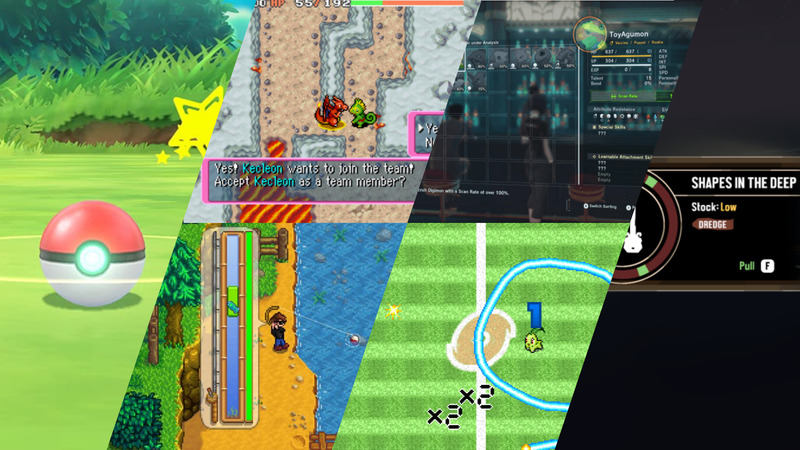
When we started working on our capture system, the first reference was obvious: Pokémon Ranger.
You draw loops around a creature. The creature moves. If you mess up, the line breaks. Very simple. In theory.
But the more we worked on it, the more we realized that “capture” is not really one mechanic.
Pokémon, Pokémon Mystery Dungeon, Digimon, Stardew Valley, DREDGE, Animal Crossing… they all have capture systems, but they feel completely different.
So we started asking a better question:
What actually makes a capture system feel good?
What is a capture system?
First, we should define what a capture system actually is.
A capture system is a game mechanic where the player tries to obtain, recruit, collect, or control a creature or living being through interaction, instead of simply defeating it.
That interaction can take many forms.
Sometimes it is a probability check with a suspicious amount of math behind it. Pokémon, of course, would never do something like that.
Other times, it is a minigame. Sometimes it is about timing, positioning, preparation, risk management, or simply understanding how that creature behaves.
In creature collecting games, capture is usually one of the most important parts of the experience. It is the moment where the player goes from seeing something in the world to adding it to their own collection.
But capture systems are not limited to monster catching games. Fishing games, bug catching mechanics, farming games, and even some RPG recruitment systems are all built around similar ideas.
The player sees something, wants it, interacts with it, and tries to bring it into their world.
Which is basically game design saying: “I saw a thing, and now it has to be mine.”
Why capture feels different from defeating
Defeating an enemy usually feels final.
You win, the enemy disappears, and the game moves on.
Very heroic. Very normal.
Capturing something creates a different kind of fantasy.
You are not just removing something from the world. You are keeping it. Maybe you can use it later, trade it, place it somewhere (wink, wink), upgrade it, or make it part of another system in the game.
That changes the emotional weight of the interaction.
The player is not only thinking about winning. They are thinking about collection, ownership, discovery, rarity, utility, and sometimes even attachment.
A good capture system creates questions like:
1. Can I get this creature?
2. Is this one rare?
3. What happens if I capture it?
4. Should I risk trying again?
5. Do I have enough resources?
6. Will this help me later?
That is why capture systems can be so memorable. They combine tension with curiosity.
And curiosity is dangerous. That is how you end up spending one more hour trying to catch something you absolutely did not need.
Pokémon: probability and preparation

The classic Pokémon games are probably the most recognizable example of a capture system.
At first glance, throwing a Poké Ball looks simple. But under the hood, the result is calculated through a formula with several variables: the creature’s catch rate, remaining HP, status conditions, the type of ball used, and randomness.
The player does not directly control the capture once the ball is thrown.
Instead, the skill is in preparing the right conditions before the attempt.
You weaken the Pokémon. Maybe you paralyze it or put it to sleep. You choose the right Poké Ball. Then you throw it and wait.
That waiting moment is the whole thing.
The ball shakes.
Once.
Twice.
Maybe three times.
And then it either works or fails, because apparently emotional damage is also part of the formula.
That small pause creates a lot of tension because the player knows they influenced the odds, but did not fully control the outcome.
And when it works, especially with a Pokémon that was missing from your Pokédex, it feels great.
Pokémon’s capture system is not really about execution. It is about preparation, probability, and anticipation.
Pokémon Mystery Dungeon: recruitment after the fight
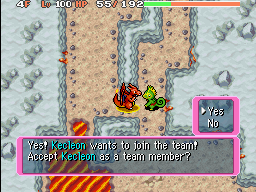
Pokémon Mystery Dungeon is another interesting example from the same franchise.
It makes sense to bring Pokémon up more than once here. It is basically the main reference point for creature capture games, and the franchise has explored the idea of capture in more than one way.
The interesting thing about Mystery Dungeon is that capture becomes more like recruitment.
You do not throw a ball at the creature during battle. Instead, enemies can join your team after being defeated, depending on conditions like the Pokémon, the dungeon, your team, and the game’s recruitment rules.
Except Kecleon, of course. They exist to remind you that some systems were designed by people who enjoy watching players suffer.
In the original Rescue Team games, there is also another important requirement: Friend Areas.
Before some Pokémon can properly join you, you need to have the right place for them to stay. Basically, you need the creature’s habitat unlocked first.
That changes the feeling quite a bit.
The creature is not being trapped inside an object. It is more like it decides to join you after the encounter, but only if your team has somewhere for it to go.
Of course, “decides” is doing some very generous work here. There is still a system behind it. Games love pretending math is friendship.
But emotionally, it feels different.
This kind of capture is less about executing a specific action and more about creating a chance for recruitment while playing through the dungeon.
It is useful because it shows that capture does not always need to happen as a direct moment. Sometimes it can be a possible outcome after an encounter, and sometimes it also depends on whether the player prepared the right space for that creature beforehand.
That is very interesting for our game, because our creatures are not meant to disappear into an abstract collection box. They need to live somewhere. They need to be placed on islands. And later, they should become companions, workers, generators, or whatever weird little job we end up giving them.
Pokémon Ranger: active capture
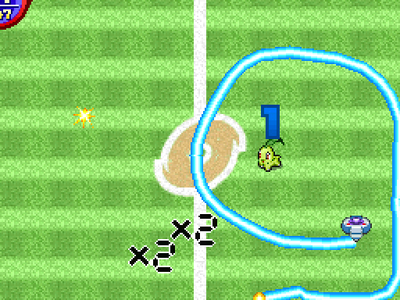
Pokémon Ranger takes the same basic fantasy of catching Pokémon and turns it into something much more active.
Instead of preparing the odds, throwing a ball, and hoping the math is in a good mood, the player has to draw loops around the Pokémon with the stylus.
That changes where the tension comes from.
In the classic games, the tension is mostly in the result. Did it work or not?
In Ranger, the tension is in the action itself.
You are following the creature, reacting to its movement, trying to close loops, and avoiding interruptions. The capture is not just something that happens after you choose an option from a menu. It is the thing you are physically doing.
That is one of the reasons it became such an important reference for us.
We are not interested in copying Pokémon Ranger exactly. That would be a very elegant way to make a worse Pokémon Ranger, which, shockingly, is not the goal.
What interests us is the feeling behind it: capture as an active interaction, where the player is part of the attempt instead of just triggering it.
Drawing loops gives the player something immediate to do. It creates room for skill, mistakes, pressure, and improvement.
It also creates room for the system to break in funny ways during development, which is less inspirational but very real.
Digimon: scanning and data collection
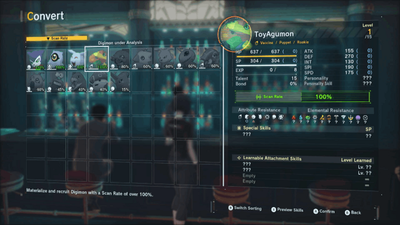
Digimon gives us another type of capture system: scanning.
In some Digimon games, encountering or fighting a Digimon increases scan data. Once the scan reaches 100 percent, the player can create or convert that Digimon.
This is a very different fantasy from throwing a ball.
You are not catching the creature directly. You are collecting enough data to recreate it.
That makes capture feel more gradual. The player does not always get the creature immediately, but every encounter contributes to progress.
That is interesting for us because it connects really well with incremental design.
Even if you fail to capture something, maybe you still learned something about it. Maybe you gained data, energy, fragments, frequency, or some kind of partial progress.
That can make failed attempts feel less wasted.
And honestly, that is a pretty useful trick, because players tend to dislike spending time on something and getting absolutely nothing back. Which is a bold thing to say from someone with more than 1,000 hours in League of Legends.
Stardew Valley: control and tension
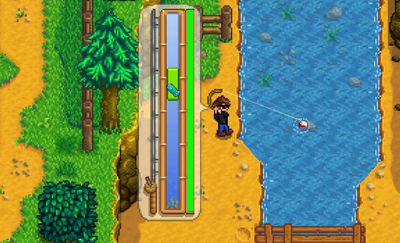
Fishing in Stardew Valley is another interesting kind of capture system.
The player is not drawing around the fish or rolling a probability check. Instead, they control a green bar and try to keep the fish inside it long enough to fill a progress meter.
This creates a different type of challenge.
It is about maintaining control under pressure.
The fish moves. The player reacts. The bar has weight and momentum. Easy fish feel calm, while difficult fish feel like they personally hate you.
The capture is not resolved in one moment. It is a short struggle.
That makes every fish feel slightly different depending on its movement pattern.
This is something we think is very valuable: the behavior of the thing being captured can define the feeling of the capture itself.
A creature does not need a giant list of stats to feel different. Sometimes, just changing how it moves is enough to make the whole interaction feel different.
DREDGE: timing, risk, and pressure
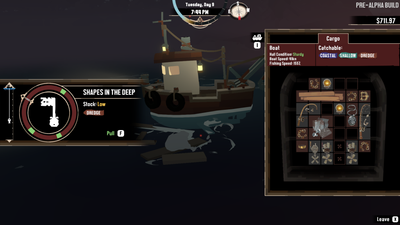
DREDGE is a great example because its fishing system is not interesting only because of the minigame itself.
The actual fishing interactions are short and based on timing. The player reacts to patterns and tries to hit the right moment to speed up the catch.
But what makes DREDGE stand out is everything around that action.
Fishing takes time.
Time matters.
Staying out too long can become dangerous. The world changes. Night approaches. The player has to decide whether to keep fishing, return to safety, or risk one more catch.
And obviously, the correct gamer decision is usually “one more catch,” right before something terrible happens.
DREDGE also adds inventory pressure. Fish and items take space in the boat, so catching something is not just a reward. It is also a spatial decision.
Do I have room for this?
Is this fish worth the space?
Should I throw something away?
That turns capture into a broader decision about risk, time, and value.
This is the part that interests us the most: the capture system does not end when the creature or fish is caught. The systems around it can make that moment more meaningful.
Animal Crossing: positioning and timing
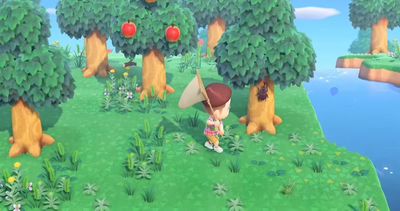
Animal Crossing has one of the simplest capture systems, but it works because it is easy to understand and immediately readable.
You see a bug. You approach carefully. You swing the net.
That is almost the whole system.
But even in that simplicity, there is timing, positioning, and anticipation.
Some bugs escape if you move too fast. Some require you to approach slowly. Some appear only at certain times or places.
This shows that a capture system does not always need to be complex to be satisfying.
Sometimes, clear rules and a strong collection loop are enough.
Which is annoying, because as developers we sometimes want the answer to be “add five more systems.” Sadly, no.
What these systems teach us
Looking at these examples, capture systems can be understood by the type of skill or decision they ask from the player.
Pokémon is about probability and preparation. It asks the player to improve the odds before trying.
Pokémon Mystery Dungeon is about recruitment as an outcome. It asks the player to create the right conditions, including having the right place for some creatures to stay, and then hope the creature joins after the encounter.
Pokémon Ranger is about active drawing. It asks the player to execute loops under pressure.
Digimon is about data accumulation. It asks the player to encounter or fight creatures enough times to complete their scan data.
Stardew Valley is about a control minigame. It asks the player to maintain precision over time.
DREDGE is about timing and risk management. It asks the player to decide how much risk is worth taking.
Animal Crossing is about positioning and timing. It asks the player to approach carefully and act at the right moment.
The interesting thing is that all of these systems are about capture, but they feel completely different.
That is because capture is not one specific mechanic.
Capture is the goal.
The actual mechanic depends on the kind of experience we want to create.
Looking at more creature collecting games makes that even clearer.
Some games let you recruit monsters after battle. Some let you scan data until you can recreate them. Some games make you collect parts. Some make you dig up fossils and revive them. Some even let you record creatures onto cassette tapes, because apparently throwing balls was not weird enough.
All of those are capture systems in a broader sense, but each one creates a different fantasy.
That was the useful realization for us. We were not just making “a system inspired by Pokémon Ranger.” We were making our own version of an active capture system, and that means we need to understand what feeling we actually want.
Our approach: active creature capture
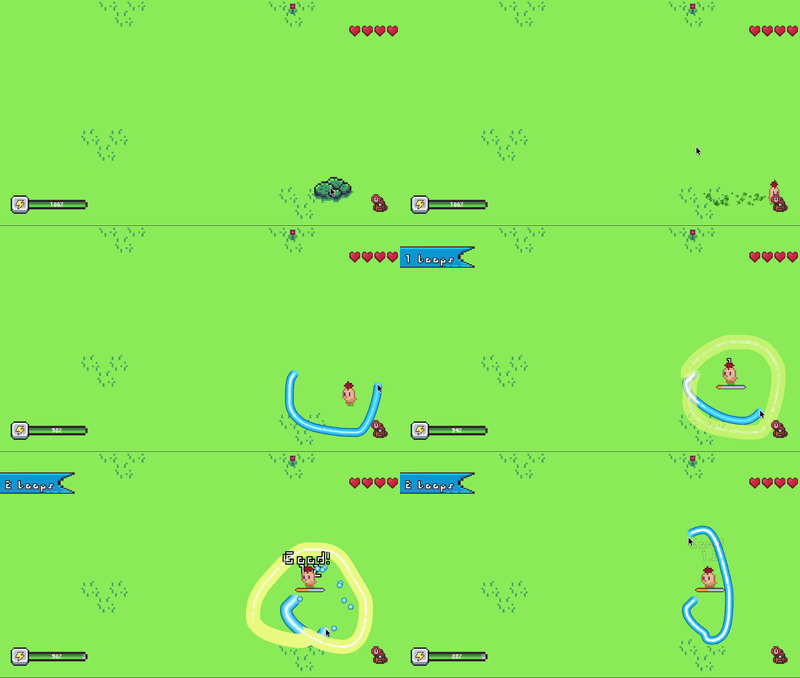
For our game, we wanted capture to be active.
Not just a button press.
Not only a random chance.
Not just something that happens after combat.
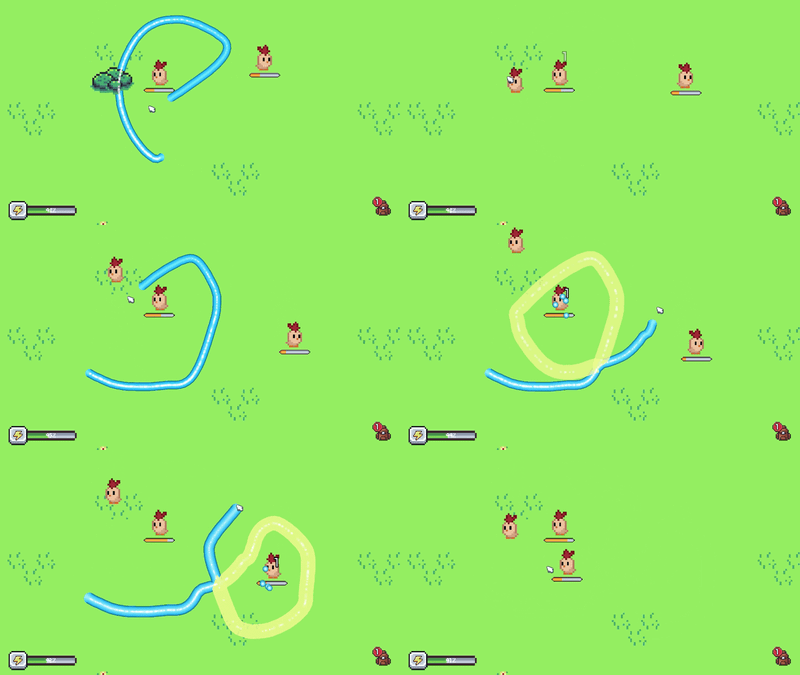
We are building a system where the player draws loops around creatures to capture them.
The creature moves inside the capture area. The player has to follow its movement, close loops, and avoid mistakes. Each successful loop adds capture progress.
This makes the capture feel more physical and immediate.
The player is not waiting for the game to decide. They are participating directly in the attempt.
That is the feeling we want to explore.
But active systems come with a small problem: the player actually has to do the thing.
Shocking, I know.
So the question becomes a little more uncomfortable: how do we make that action deep enough to survive repetition?
Because that is the real challenge.
Drawing loops around creatures sounds fun as a prototype. The question is whether it can become a system with enough depth to support a full game.
Why has this kind of capture system not been used more often? Is it because Pokémon Ranger already explored most of what made it work? Is it because it is harder to expand than it looks? Is it because everyone wisely decided not to build something that feels too close to one of the biggest creature catching franchises on the planet?
Could be all of the above. Very comforting thought, obviously.
For us, that means we cannot rely only on the loop drawing idea. The loop is the starting point, not the whole system.
The challenge: making capture scale
One of the first problems we found is that capturing one creature feels manageable.
Then we added more than one creature.
That was when the system politely informed us that difficulty does not always grow in a reasonable way.
With one creature, the player can focus on its movement. With two, they need to track multiple positions, avoid multiple threats, and still draw useful loops.
The difficulty does not grow linearly. It can start feeling exponential very quickly.
That creates an interesting design question:
How do we let the player deal with harder captures without making the system feel unfair?
For us, the answer is not to remove the challenge completely.
The answer is to give the player more power over time.
At the beginning, capture should feel manual and a little fragile. The player draws loops, reacts to movement, avoids mistakes, and learns how each creature behaves.
But as the game progresses, the player should unlock ways to handle that pressure better.
Maybe the line becomes stronger. Maybe it can survive one or two mistakes before breaking. Maybe some tools slow down creatures, stun them for a moment, or make their movement easier to read. Maybe upgrades increase the value of each loop, reduce the number of loops needed, or make multicapture more rewarding.
This is where the incremental side of the game becomes important.
Progression should not only increase numbers in the economy. It should also make the capture system feel better, smoother, and more powerful.
The fantasy is not only:
I am better at capturing creatures.
It is also:
My capture setup is stronger now.
That means early creatures that felt difficult at the start can become easy later. Some common creatures may eventually require very little effort. Some could even become almost automatic with the right upgrades or devices.
But that does not mean the whole system becomes passive.
Rare creatures, dangerous creatures, or new creature types can still ask for active play. The player gets stronger, but the game can keep introducing new situations where that extra power matters.
That creates a better progression curve:
1. Early captures teach the basics.
2. Upgrades make familiar captures easier.
3. Multicapture becomes more manageable.
4. Common creatures become faster to catch.
5. Rare creatures still create tension.
6. New behaviors create new problems to solve.
The goal is to let the player feel stronger without losing the active feeling that makes the system interesting.
Basically: we want the player to earn the right to make older problems look easy.
That is one of the best feelings in incremental games.
Capture as a bigger system
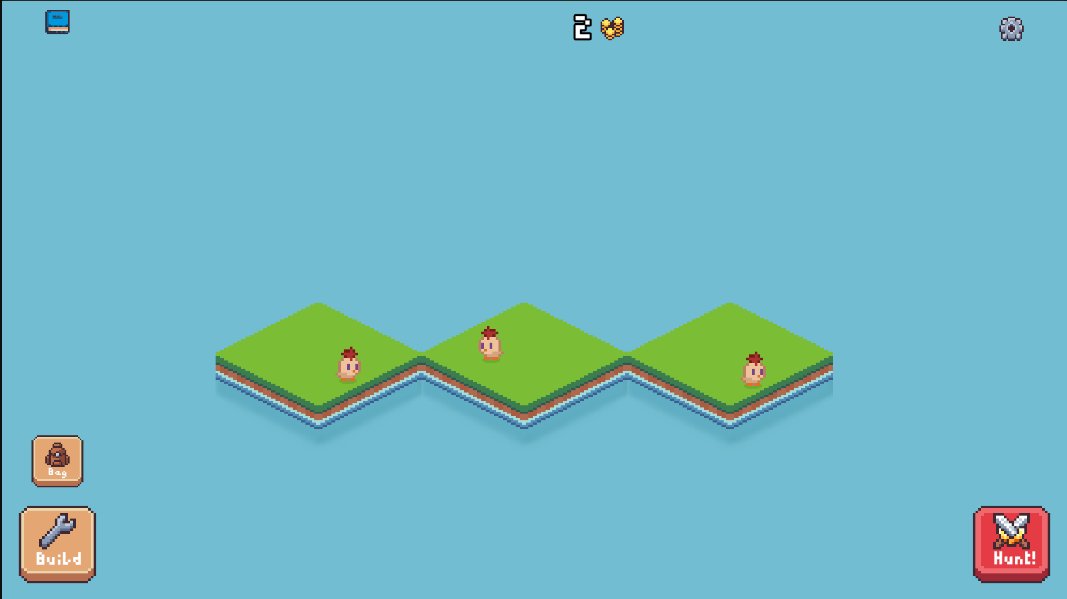
Another thing we are thinking about is how capture connects with the rest of the game.
Capturing should not be isolated.
It should affect what happens after.
Once a creature is captured, it can become part of your collection, your island, your economy, or your upgrade path.
That means the capture system is also connected to progression.
A rare creature should not only be harder to capture. It should make the player excited because it changes what they can do later.
This is where games like DREDGE are especially inspiring.
The fishing minigame is only one part of the experience. The real tension comes from how fishing connects to time, inventory, money, danger, upgrades, and exploration.
For our game, we want capture to connect to creature placement, island progression, passive generation, upgrades, automation, and maybe even creature variants or energy types.
Because if we are going to make players draw loops around tiny creatures, we should probably make sure those creatures matter after that.
Final thoughts
A good capture system is not only about the moment something is caught.
It is about the tension before it happens, the decision to try, the risk of failing, and the reward of adding something new to your world.
Pokémon makes capture feel like anticipation.
Pokémon Ranger makes it feel active.
Pokémon Mystery Dungeon makes it feel like recruitment and preparation.
Digimon makes it feel like data collection.
Stardew Valley makes it feel like maintaining control under pressure.
DREDGE makes it feel like risk.
Animal Crossing makes it simple and collectible.
For our game, we are trying to build a capture system that feels active, readable, and satisfying, while still leaving room for strategy, upgrades, automation, and different creature behaviors.
It is still early, and we are still figuring out what works and what breaks immediately after we add a second creature to the screen.
But that is the fun part.
Probably.
Join the process
Join our newsletter HERE